Best 12-Passenger Vans for 2026
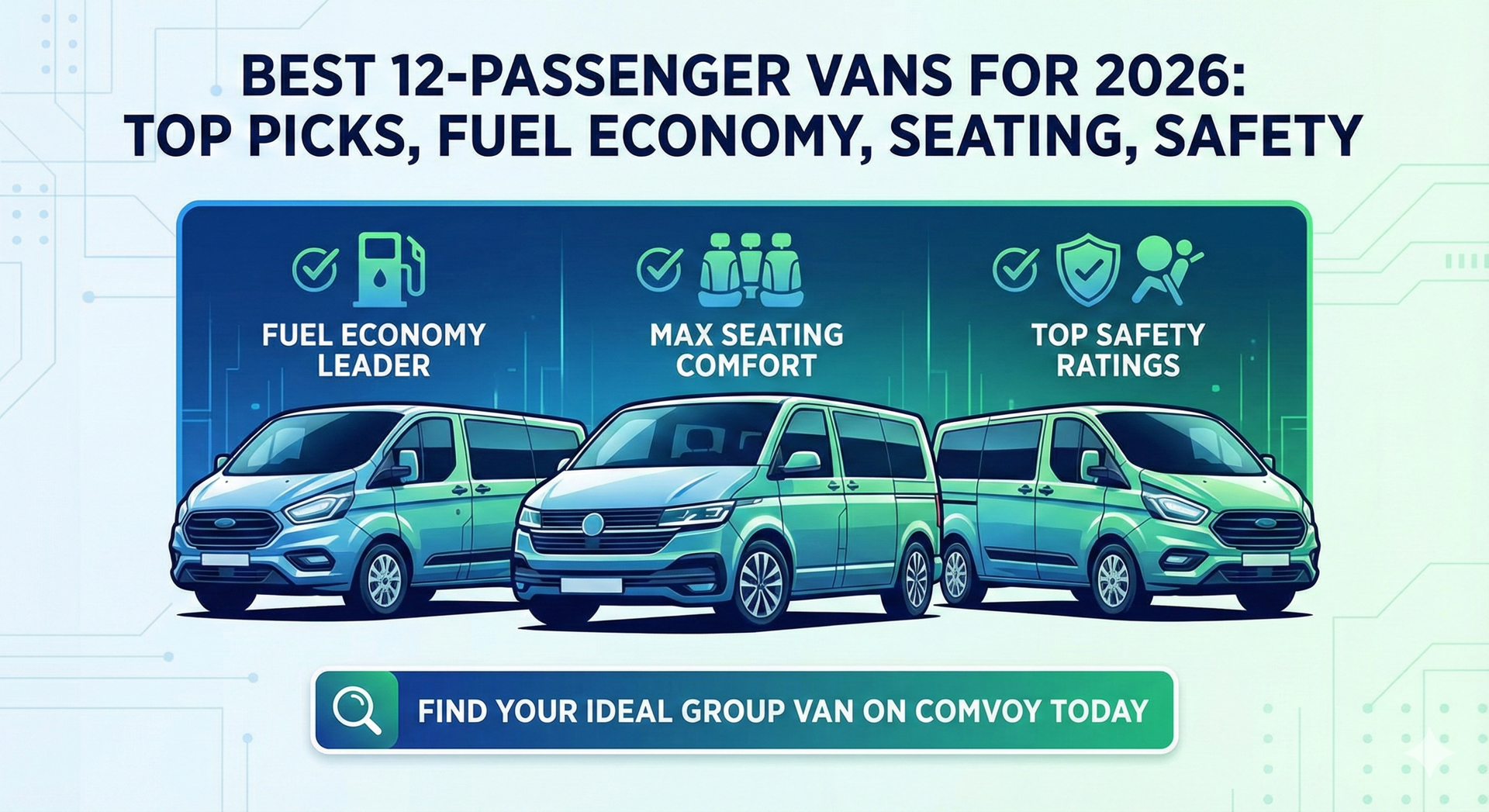
Best 12-Passenger Vans for 2026
Best 12-Passenger Vans for 2026
Twelve-passenger vans continue to be a reliable choice for transporting crews, students, and guests. They deliver full seating capacity without the added licensing of larger commercial vehicles.
This 2026 buyer’s guide covers the top models available today, the features to compare, and how to find inventory fas
Why 12-Passenger Vans Matter
A 12-passenger van transports large groups safely and comfortably. With seating for a driver and 11 passengers, it's ideal for churches, schools, hotels, and business crews.
Its key advantage over 15-passenger vans is simpler licensing. While many states require a Commercial Driver's License (CDL) for 15-passenger vehicles, 12-passenger models typically don't, which simplifies operations.
Moreover, 12-passenger vans are also more stable than larger vans, with a lower rollover risk. The reduced seating creates more cargo space for luggage or equipment. They transport people comfortably while avoiding the added licensing requirements that come with bigger vehicles.
Key Specs & Features to Compare
Choosing the right passenger van means looking past the price tag to find a model that fits your daily needs. The right specs determine the van's safety, comfort, operating costs, and longevity.
When comparing models, focus on how they perform in real use, not on brochure language. Their features should align with your use case, from daily shuttles to occasional trips.
1. Seating Layout and Capacity
Most 12-passenger vans use a 2-3-3-3 or 2-3-4-3 seating configuration with a center aisle for easier movement and emergency access.
When evaluating seating, consider these key factors:
- LATCH Anchor Availability: Essential for child seats in school and camp applications
- Seat Removal Options: Some models allow reconfiguration for extra cargo space
- Aisle Width: Affects passenger comfort and accessibility compliance
When making these seat changes, make sure they won’t affect your van’s certification or insurance coverage.
2. Engines, Fuel Economy, and Maintenance
Most 12-seating passenger vans come with two engine types to choose from.
- V6 engines provide sufficient power and better fuel economy for city routes.
- V8 engines deliver more torque for towing or highway use but are less fuel-efficient.
Diesel options, like in the Mercedes-Benz Sprinter, offer excellent highway fuel economy but have a higher upfront cost. These vans often share parts with cargo vans and light-duty trucks. This helps keep maintenance costs predictable and makes parts easier to find.
3. Safety & Driver Assistance Features
Modern passenger vans include advanced safety systems to protect passengers and reduce driver fatigue. These features may also help reduce insurance costs, which benefits organizations running multiple vehicles.
Look for these essential safety technologies:
- Forward Collision Alert with Automatic Emergency Braking: Warns and can brake if a collision is imminent
- Lane Departure Warning: Alerts when the vehicle drifts from its lane
- Blind Spot Monitoring: Side-mirror alerts for vehicles in blind zones
- Rear Vision Camera: Standard on most models for safer backing
- Electronic Stability Control: Reduces traction loss and improves stability
Aside from these, make sure side-curtain airbags cover all seating rows if you want full protection for every passenger.
4. Upfit and Customization for Large-Group Use
An upfit is specialized equipment added after manufacturing to meet specific needs. Many 12-passenger vans are designed to accommodate these modifications without compromising structural integrity.
Common upfits include wheelchair lifts for ADA compliance, rear HVAC systems, vinyl flooring, and luggage racks. Upfits can add several weeks to delivery time, so plan accordingly and confirm modifications don't affect payload or warranty.
Top 12-Passenger Vans For 2026
These models offer 12-passenger seating with different strengths for various applications. Since availability varies by region, check multiple dealers for in-stock options.
Ford Transit Passenger Van (12-Seat Configuration)
The Ford Transit features a modern design, multiple roof heights, and advanced technology. Its high-roof option allows most adults to stand upright, making boarding easier and more comfortable.
Ford Co-Pilot360 provides safety features like pre-collision assist and lane-keeping technology. The intelligent all-wheel-drive system improves traction in poor weather without raising the load floor. You can explore similar spacious van layouts, like Ford Transit 350 HD, to see its design.
Although it costs more than some competitors, the Transit delivers strong comfort and safety features that many people value. This makes it ideal for organizations prioritizing passenger experience and modern tech.
GMC Savana Passenger Van (12-Seat Configuration)
The GMC Savana uses a proven body-on-frame design for durability and heavy-duty use. This platform benefits from a long fleet service history and widespread parts availability. It’s also a popular choice for those who need large family vans that balance towing capacity with long-term reliability.
The Savana offers excellent upfit flexibility with extensive aftermarket support. Its standard rear climate controls improve comfort, and the available 6.6L V8 engine provides strong towing capacity.
Though less refined than the Transit and with lower fuel economy, it offers excellent value. This makes it a good fit for senior living facilities, paratransit services, and fleets that want proven reliability with a lower upfront cost.
Chevrolet Express Passenger Van (12-Seat Configuration)
The Chevrolet Express shares the Savana's platform, offering identical capability in a different package. It is often a highly cost-effective entry point into 12-passenger van ownership.
When comparing Transit vs. Express, the Express typically wins for upfront affordability and simplicity, while the Transit usually delivers more modern safety and technology features.
Meanwhile, the Express has the same durable design and mechanical simplicity as the Savana. Its proven reliability makes it easy and affordable to service nationwide.
Like the Savana, it lacks the modern refinement of newer competitors. However, this simplicity is perfect for budget-conscious buyers and fleet operators who prioritize total cost of ownership over the latest features.
Mercedes-Benz Sprinter Passenger Van
The Mercedes-Benz Sprinter also delivers premium comfort and refinement. Its standard high roof and spacious interior create a comfortable, luxury-like environment.
The diesel engine provides excellent highway fuel economy and strong resale value. However, the Sprinter has the highest upfront investment and more expensive maintenance than domestic models.
It’s a solid choice for luxury shuttle operators, high-end hotels, and businesses that value passenger comfort and strong resale value.
How to Choose the Right One for Your Needs
Choosing a van that matches how you’ll use it helps keep costs down and makes ownership easier in the long run. The right choice depends on your routes, passengers, and budget.
Family vs. Commercial Group Transport
Personal and commercial needs differ, so focus on the features that matter most for how you plan to use the van.
For personal use, focus on comfort features like rear HVAC, quiet cabins, and advanced safety tech. All-wheel drive improves weather capability, while high roofs add headroom.
Commercial applications demand durability and upfit readiness over comfort. Prioritize features that reduce liability and insurance costs, like driver-assist technology and ADA-compliant options. Consider vinyl flooring for easy cleaning in high-turnover use.
Budget vs. Total Cost of Ownership
The purchase price is only part of the total cost of ownership. Consider these ongoing costs when comparing options:
- Fuel Expenses: V6 engines typically offer better economy than V8s, while diesel engines often provide superior highway mileage.
- Maintenance Costs: Domestic vans generally cost less to service than imported models.
- Insurance Premiums: Modern safety features can reduce commercial insurance rates.
- Downtime Impact: Reliable vans with strong dealer support help reduce downtime and keep your schedule on track.
Used vans with low mileage can provide significant savings, but inspect their service history and upfit condition carefully.
Resale Value and Future-Proofing
Twelve-passenger vans hold their value well due to broad demand and fewer regulations than larger models. Popular features like high roofs, all-wheel drive, and safety packages command higher resale prices.
For long-term ownership (5+ years), prioritize durability and service network strength. For shorter ownership, focus on features and brand reputation that maximize resale value. Diesel vans often have stronger resale value due to their longevity and fuel economy.
FAQs
Here are answers to common questions about purchasing and operating 12-passenger vans.
Can I still buy a 12-passenger van with new safety regulations in effect?
Yes, Ford, GMC, and Chevrolet still offer 12-passenger models for 2025/2026 with updated safety features like automatic emergency braking now standard or available.
What makes a 12-passenger van different from a 15-passenger van?
A 12-passenger van has one fewer row, increasing cargo space and often eliminating CDL requirements. Fifteen-passenger vans face stricter rules due to a higher rollover risk.
Should I buy a new or used 12-passenger van for my organization?
New vans offer the latest safety tech and a full warranty. Used models can save money but require careful inspection of their service history and any upfits.
Do I need a commercial driver's license to operate a 12-passenger van?
Most states don't require a CDL for personal or nonprofit use, but some do for for-hire services or if the vehicle's combined weight exceeds certain limits.
Which 12-passenger van offers the most comprehensive safety features?
The 2026 Ford Transit generally offers a comprehensive standard safety package with numerous driver-assist systems.
How much cargo space do I get behind the last row in a 12-passenger van?
Extended-wheelbase, high-roof models offer the most space for luggage. Check specific vehicle listings for exact dimensions.
Can I add wheelchair accessibility to any 12-passenger van?
Yes, all major models can accommodate ADA-compliant wheelchair lifts. High-roof models are ideal for accessibility and interior space; confirm payload capacity with your upfitter before ordering.
Choosing the Right 12-Passenger Van
Choosing the right 12-passenger van requires matching the vehicle's strengths to your operational needs and budget.
Twelve-passenger vans balance seating capacity, cargo space, and regulatory compliance for most group transport needs. Whether you choose the Ford Transit, GMC Savana, Chevrolet Express, or Mercedes-Benz Sprinter, match the vehicle to your specific requirements and budget.
Browse Comvoy's nationwide inventory of passenger vans to compare detailed specifications and find available models from dealers in one transparent marketplace.
CTA Button: Shop Passenger Vans
Sources:
- National Highway Traffic Safety Administration (NHTSA). NHTSA Finalizes Key Safety Rule to Reduce Crashes and Save Lives. https://www.nhtsa.gov/press-releases/nhtsa-fmvss-127-automatic-emergency-braking-reduce-crashes
- Insurance Institute for Highway Safety (IIHS). IIHS-HLDI research finds little evidence that partial automation prevents crashes. https://www.iihs.org/news/detail/iihs-hldi-research-finds-little-evidence-that-partial-automation-prevents-crashes
- Cornell Law School. 49 CFR § 383.5 - Definitions. https://www.law.cornell.edu/cfr/text/49/383.5
- GMC. 2025 GMC SAVANA. https://www.gmc.com/vans/previous-year/savana/passenger
- Chevrolet. 2026 Chevy Express Vans | Cargo & Passenger | Chevrolet. https://www.chevrolet.com/commercial/express/vans