


Ford Transit 150 vs Chevrolet Express 2500: Which Is Better in 2026?
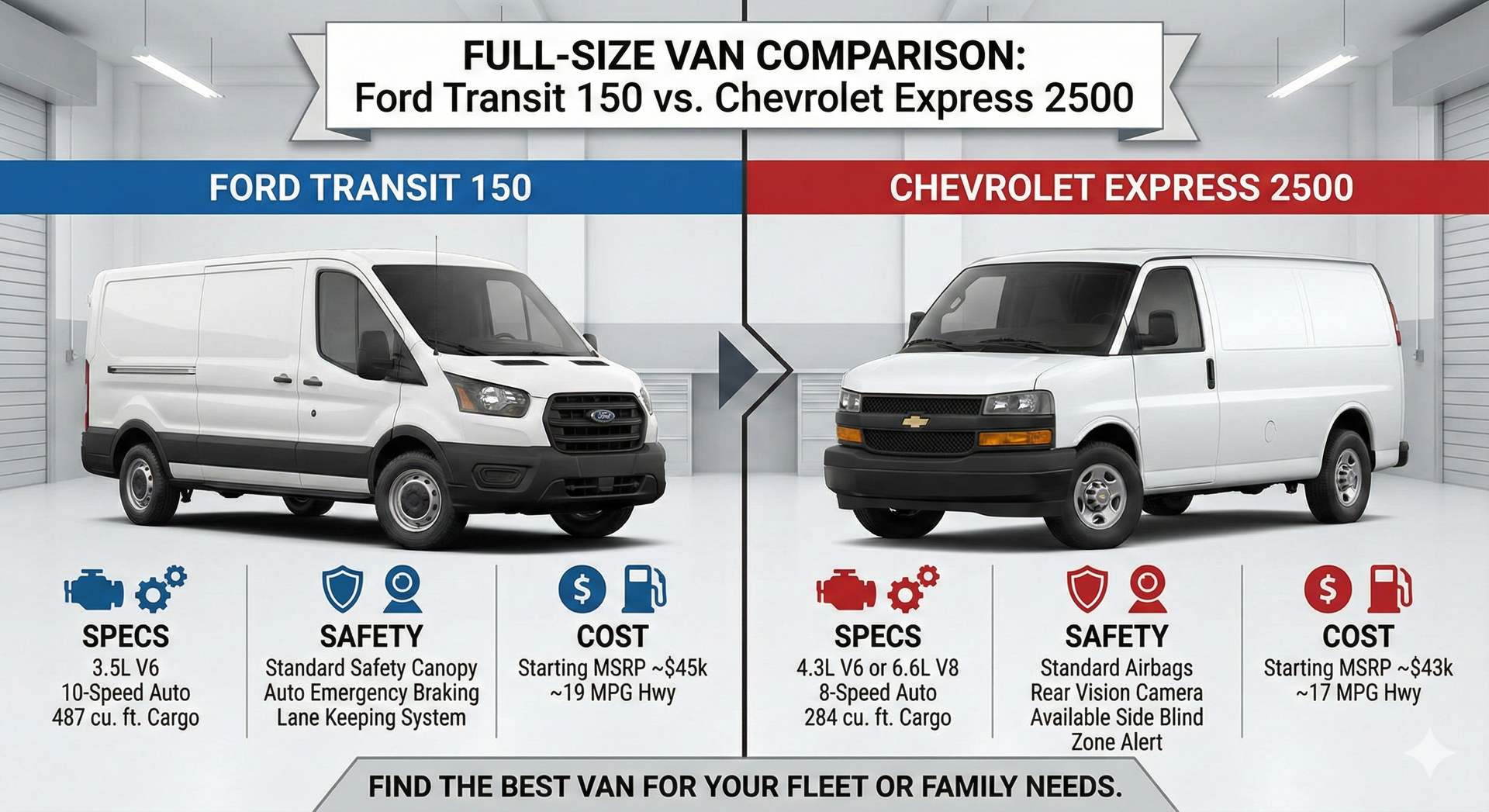
Ford Transit 150 vs Chevrolet Express 2500: Which Is Better in 2026?
Ford Transit vs Chevy Express: Reliability, Cost & Features Comparison
Choosing between the Ford Transit and Chevrolet Express often comes down to whether you value modern comfort or rugged durability. The Transit offers updated safety features and flexible configurations, while the Express delivers classic strength and lower long-term repair costs.
This comparison focuses on full-size passenger vans designed to accommodate 12 to 15 passengers. These vans are the workhorses of shuttle services, church groups, schools, hotels, and commercial transport operations. We'll break down seating layouts, powertrain differences, safety technology, and real-world operating costs to help you choose the right van for your routes and budget.
Overview of Each Model
The Ford Transit and Chevrolet Express take two very different approaches to passenger van design. The Transit's modern unibody construction provides a smoother ride. In contrast, the Express's traditional body-on-frame build prioritizes towing and ruggedness. Both models can serve as large family vans, but the Transit’s high-roof option offers noticeably better comfort during long trips.
Ford Transit 150 Passenger – Modern Design, Multiple Configurations
The Ford Transit features unibody construction, where the body and frame are a single piece. This car-like structure delivers a stiffer, smoother ride for passengers.
The Transit stands out for its roomy interior. Its medium and high-roof options offer far more headroom than traditional vans, making it easier for passengers to enter, exit, and move around. You can also choose from three lengths with seating for 12, 14, or 15 passengers.
It comes with a standard 3.5L V6 and smooth 10-speed automatic transmission, with an optional EcoBoost V6 if you need more power. All-wheel drive is also available, making it a great choice for families in snowy or rainy climates.
Chevrolet Express 2500 Passenger – Proven Platform, Heavy-Duty Towing
The Chevrolet Express uses traditional body-on-frame construction, where the body sits on a separate steel frame like a pickup truck. You can find reliable Express 2500 passenger vans with this proven design.
Due to its traditional design, the Express is available in only one roof height and two wheelbase options, accommodating either 12 or 15 passengers. It’s simple, sturdy, and built for straightforward performance.
Side-by-Side Spec Comparison
When evaluating the best passenger vans, safety tech, fuel efficiency, and roof height options are often the deciding factors. Here’s a detailed comparison:
|
Feature |
Ford Transit 150 Passenger |
Chevrolet Express 2500 Passenger |
|
Seating Capacity |
12, 14, or 15 passengers |
12 or 15 passengers |
|
Roof Height Options |
Medium, High |
Standard (one height) |
|
Wheelbase Options |
130″, 148″, 178″ |
135″, 155″ |
|
Standard Engine |
3.5L V6 (275 hp / 260 lb-ft) |
4.3L V6 (276 hp / 298 lb-ft) |
|
Optional Engine |
3.5L EcoBoost V6 (310 hp / 400 lb-ft) |
6.6L V8 (401 hp / 464 lb-ft) |
|
Transmission |
10-speed automatic |
8-speed automatic |
|
Drivetrain |
RWD or AWD |
RWD only |
|
Max Towing Capacity |
~6,500 lbs (varies by config) |
~10,000 pounds |
|
Fuel Economy (city/hwy) |
Better with EcoBoost |
Lower overall |
|
Safety Tech |
Standard AEB, lane-keep assist, available 360° camera |
Available forward collision alert (no AEB standard) |
|
Construction |
Unibody |
Body-on-frame |
|
Starting MSRP (approx.) |
Mid-range |
Lower base price |
Seating & Cargo Space Behind the Last Row
The Transit offers more seating flexibility with a 14-passenger option, and its high-roof model allows most adults to stand upright, easing entry and exit. The Express is limited to 12 or 15 seats with a lower, more cramped roof. While both vans allow seat removal for cargo or wheelchair lifts, the Transit's modular design simplifies reconfiguration.
Engine Options & Fuel Economy
The Transit's EcoBoost engine provides strong acceleration and better fuel economy, ideal for long routes and urban driving. In contrast, the Express's V8 offers raw towing power but consumes more fuel. The Transit's fuel savings can offset its higher purchase price over time, particularly for high-mileage operations.
Safety & Driver-Assist Technology
The Transit comes standard with Automatic Emergency Braking (AEB), lane-keeping assist, and offers an available 360-degree camera. Modern AEB systems can prevent low-speed collisions, which protects passengers and may lower insurance costs for organizations running frequent routes.
Meanwhile, the Express offers optional Forward Collision Alert but lacks standard advanced safety tech. For safety-conscious fleets, the Transit has a clear advantage. A fleet passenger van buyer guide explains how safety features impact ownership costs.
Real-World Use & Fit Scenarios
Your choice depends on your routes, passenger needs, and budget. Here's how each van performs in common work situations.
1. Best for Shuttle Services & Hotel/Airport Runs
The Ford Transit excels in passenger comfort with its high roof, smooth ride, and available AWD for winter weather. The Chevrolet Express suits budget-conscious operators who need proven reliability. It handles flat routes with moderate luggage, but passenger comfort is lower on long trips.
2. Best for Churches, Schools & Non-Profit Group Transport
The Transit's safety features and ADA-ready configurations protect passengers and volunteers, with driver aids that reduce risk for inexperienced drivers. The Express fits tight budgets with a lower upfront cost and familiar driving dynamics. Local shops can easily service their simpler mechanics, which reduces maintenance complexity.
3. Best for Fleet Operators & Commercial Transport
High-mileage fleet operations benefit from the Transit's fuel efficiency and telematics, which control operating costs. Its multiple wheelbase options maximize passenger count without sacrificing comfort. The Express's superior towing capacity supports trailers, and its body-on-frame durability appeals to fleets running vehicles hard.
Therefore, fleets should weigh the Transit's efficiency for high-mileage routes against the Express's raw power and durability for demanding jobs.
Strengths & Weaknesses of Each Van
Understanding each van's trade-offs helps you make the right choice for your operation.
What Makes the Ford Transit Shine
The Transit's modern design offers key advantages:
- Advanced safety: Standard AEB and lane-keeping assist protect passengers and reduce liability.
- Fuel efficiency: The EcoBoost engine cuts long-term operating costs.
- Flexibility: Multiple roof heights and wheelbases allow for customization.
- All-weather capability: Available AWD improves traction in snow and on unpaved roads.
- Proven adoption: The Transit holds a 54% share in the utility services industry, which demonstrates its commercial success.
Where the Ford Transit Falls Short
The Transit's drawbacks include:
- Higher price: More expensive upfront, especially with added safety packages.
- Service needs: Some systems require dealer service.
- Limited towing: Lower maximum trailer capacity than the Express.
What Makes the Chevrolet Express Shine
The Express's traditional design offers proven benefits:
- Maximum towing: The optional V8 handles heavy trailers and equipment.
- Durability: Body-on-frame construction and simple mechanics are reliable.
- Lower cost: A more affordable base price fits tight budgets.
- Easy service: Most independent mechanics can service the familiar platform.
Where the Chevrolet Express Falls Short
The Express's older platform has notable drawbacks:
- Single roof option: Less headroom and flexibility than the Transit.
- Poor fuel economy: The V8 engine increases operating costs.
- No AWD: RWD-only limits performance in winter weather.
How to Choose the Right Van for Your Operation
Match your decision to your routes, budget, and operational needs.
1. Budget & Total Cost of Ownership
While the Express has a lower starting price, consider long-term costs. The Transit's better fuel economy reduces operating expenses, especially for high-mileage use. The Express benefits from simpler repairs and wider parts availability.
- Upfit & Customization Needs
Your upfit and equipment needs should guide your choice. The Transit's high-roof option and modular interior suit ADA lifts and standing workspaces. For towing heavy trailers, the Express's superior capacity is the clear choice. Consider which platform better accommodates your required modifications.
3. Safety, Compliance & Insurance Considerations
Safety technology impacts accident prevention and insurance costs. The Transit's standard driver-assist systems reduce risk and may lower fleet premiums. Federal mandates requiring AEB by 2029 will save an estimated 360 lives annually nationwide. These features are especially beneficial for organizations with volunteer drivers.
Please note that insurance costs for 12-passenger vans tend to increase, particularly when used for commercial group transportation.
FAQs
Does Chevrolet still update the Express passenger van design?
The Express receives minimal updates, focusing on proven durability over new technology. Current models like the 2024 Chevrolet Express extended passenger van continue this approach.
Which passenger van provides better torque for towing trailers?
The Express with the optional 6.6L V8 delivers superior torque and towing capacity, making it ideal for heavy trailer use.
Which van maintains better resale value over time?
The Transit often holds value better due to its modern features and efficiency. The Express appeals to budget buyers, prioritizing reliability and lower maintenance costs.
Can you get all-wheel drive on both passenger vans?
Only the Ford Transit offers optional all-wheel drive; the Express is exclusively rear-wheel drive.
Which passenger van is easier to service and maintain?
Thanks to its straightforward construction and common parts, most independent mechanics can work on the Chevrolet Express. The Transit may require dealer service for some systems, but it has longer service intervals.
Find the Right Passenger Van on Comvoy
Once you know which van fits your operation, Comvoy helps you find the right configuration. Our platform provides unbiased and transparent listings from a nationwide inventory of work-ready trucks and vans.
Use our filters for seating, roof height, and wheelbase to compare options. Browse our inventory of passenger vans to compare Ford Transit and Chevrolet Express models, then connect with dealers to finalize your purchase. Find the right truck, in the right place, at the right time.
Sources:
- AAA Newsroom. Out with the Old (Automatic Emergency Braking), In with the New. https://newsroom.aaa.com/2024/10/out-old-aeb-in-new/
- Motor Trend. 2025 Chevrolet Express. https://www.motortrend.com/cars/chevrolet/express/2025
- Work Truck Online. The Ford Transit: A Revolution for Commercial Fleets. https://www.worktruckonline.com/10220706/the-ford-transit-a-revolution-for-commercial-fleets
- Reuters. US to require new cars to have emergency braking systems by 2029. https://www.reuters.com/business/autos-transportation/us-require-new-cars-have-emergency-braking-systems-by-2029-2024-04-29/


