


What is The Section 179 Deduction and Bonus Depreciation for Commercial Vehicles?

What is The Section 179 Deduction and Bonus Depreciation for Commercial Vehicles?
As of 2025, key tax provisions affecting commercial vehicle purchases have been updated, including expanded limits for Section 179 and changes to bonus depreciation. These updates may allow businesses to deduct a substantial portion—or even the full cost—of qualifying trucks and vans in the year they’re acquired.
This article outlines how Section 179 and bonus depreciation work, what’s changed for 2025, and how these provisions may apply to your next vehicle purchase. Whether you're replacing a single work truck or expanding your fleet, understanding these rules can help you plan more effectively.
What is Section 179?
Section 179 is a provision in the Internal Revenue Service tax code that allows business owners to deduct the full purchase price of qualifying new or used work trucks and vans in the year they are purchased rather than depreciating the cost over several years.
Section 179 can significantly reduce your tax burden by allowing you to offset the entire cost of a vehicle purchase against your taxable income in the same year, up to the annual limit. This frees up cash flow and can make acquiring new equipment more affordable.
Section 179 Deduction Opportunity and Limits for 2025
To qualify for the Section 179 deduction in 2025, the vehicle must be purchased, financed, or leased and placed into service during the 2025 tax year. It must also be used more than 50% of the time for business purposes.
For 2025, businesses can deduct up to $2,500,000 in qualifying equipment and software purchases. This deduction begins to phase out on a dollar-for-dollar basis once total purchases exceed $4,000,000, and is fully phased out at $6,500,000. These limits were expanded and made permanent under the One Big Beautiful Bill Act (OBBBA).
Bonus depreciation, or special depreciation allowance, is another tax incentive that allows businesses to deduct a significant percentage of the cost of qualifying assets in the first year they are placed in service. It works alongside Section 179 and can provide additional tax savings.
If your purchases exceed the Section 179 limit, bonus depreciation may still apply to the remaining cost. For 2025, bonus depreciation is:
- 100% for qualifying property acquired on or after January 20, 2025
- 40% for property acquired before that date and placed in service during 2025
2025 Deduction Limits at a Glance
Provision | 2025 Thresholds & Details |
Section 179 Limit | Up to $2.5 m in deductions for qualifying purchases |
Phase-Out Begins | At $4,000,000 in total equipment purchases |
Full Phase-Out | Deductions fully phased out at $6,500,000 |
Bonus Depreciation | - 100% (up to $2.5m) for property acquired on or after Jan 20, 2025 - 40% (up to $2.5m) for property acquired before Jan 20, 2025 and placed in service in 2025 |
Vehicle Use Rule | Must be used >50% for business |
GVWR Advantage | Vehicles over 6,000 lbs GVWR are exempt from luxury auto caps |
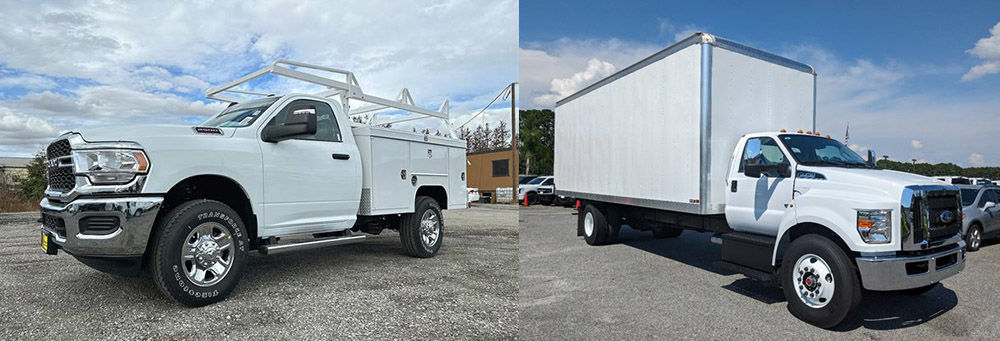
Commercial vehicles, like box trucks and service trucks, are eligible for Section 179 deductions.
Example:
Suppose your business purchases two service trucks in 2025 for a combined cost of $180,000. Both vehicles meet IRS criteria: used more than 50% for business, placed in service during the tax year, and have a gross vehicle weight rating (GVWR) over 6,000 lbs.
Here’s how the deductions could apply:
- Section 179 Deduction
You may deduct the full $180,000 under Section 179, assuming your total qualifying purchases for the year remain below the $2.5 million limit. This deduction applies in the year the vehicles are placed in service. - Bonus Depreciation (if needed)
If your total purchases exceed the Section 179 limit, bonus depreciation can apply to the remaining cost. However, the percentage depends on when the vehicles were acquired:
- 100% bonus depreciation applies to qualifying property acquired on or after January 20, 2025.
- 40% bonus depreciation applies to property acquired before that date and placed in service in 2025.
This distinction matters: even if a vehicle is placed in service in 2025, the acquisition date determines which bonus depreciation rate applies.
Here's a breakdown of key things to know about bonus depreciation:
- How it works: Bonus depreciation allows businesses to deduct a large portion—or in some cases, the full cost—of qualifying assets in the year they’re placed in service. This accelerates tax savings compared to traditional depreciation methods.
- Qualifying assets: Most new and used equipment, machinery, and certain other property with a recovery period of 20 years or less qualify. Vehicles with a gross vehicle weight rating (GVWR) over 6,000 lbs typically qualify and are not subject to luxury auto caps.
- Current percentage:
- 100% bonus depreciation applies to qualifying property acquired on or after January 20, 2025.
- 40% bonus depreciation applies to property acquired before that date and placed in service during 2025.
- Phase-out status: The previous phase-out schedule (60% in 2024, 40% in 2025, 20% in 2026, 0% in 2027) was overridden by recent legislation. The 100% bonus depreciation provision has been restored and made permanent for eligible property acquired after January 19, 2025.
- Combination with Section 179: Bonus depreciation can be used alongside Section 179. Typically, businesses first apply the Section 179 deduction up to the annual limit, then use bonus depreciation on any remaining cost.
Important Notes
- Bonus depreciation rules, including federal depreciation guidelines, can be complex. Always consult a qualified tax professional for advice tailored to your business.
- The information provided here reflects current tax law as of 2025 and is subject to future changes.
By understanding both Section 179 and bonus depreciation provisions, you can maximize your tax savings when purchasing work vehicles or other qualifying equipment for your business.
How To Take Advantage Of Section 179 and Bonus Depreciation In 2025
To maximize your tax savings when purchasing commercial vehicles, consider the following steps:
- Consult a tax professional
Timing matters. Bonus depreciation rates depend on when the vehicle is acquired—not just when it’s placed in service. A qualified advisor can help you plan purchases to align with the most favorable deduction rules. - Confirm vehicle eligibility
Ensure the vehicle meets IRS criteria: used more than 50% for business, placed in service during the tax year, and has a GVWR over 6,000 lbs. - Understand the deduction sequence
Apply Section 179 first, up to the $2.5 million limit. If your purchases exceed that, use bonus depreciation on the remaining cost—keeping acquisition dates in mind. - Coordinate with your dealership
Discuss your business needs with a commercial sales consultant. They can help configure vehicles that support your operations and meet IRS requirements for accelerated depreciation. - Document everything
Keep clear records of acquisition dates, service dates, business use percentages, and financing terms. These details may be critical during tax preparation or audits.
Shop Qualifying Trucks on Comvoy
After understanding the tax benefits, the next step is finding the right commercial vehicle. Comvoy offers a nationwide inventory of work trucks, SUVs, and vans that meet Section 179 eligibility standards.
Browse thousands of unbiased, transparent listings to find vehicles that meet both your operational needs and tax requirements. Whether you are seeking service trucks for sale or box trucks for sale, the platform provides comprehensive vehicle specifications to support informed decision-making.
Find the Right Truck for the Job
Combining Section 179 expensing with the right vehicle helps you acquire valuable assets, improve your bottom line, and maintain efficiency. Before buying, confirm the vehicle qualifies for Section 179 and fits your business vehicle needs.
Before making your final decision, review the key tips for choosing the right commercial vehicle to ensure it meets both your operational needs and financial goals. The right strategy combines tax benefits with practical vehicle selection for maximum business impact.
FAQs
Here are answers to common questions contractors have about Section 179 and vehicle deductions.
Can I claim Section 179 on a financed truck?
Yes, you can take the full Section 179 deduction in the year you place a financed vehicle in service, even while making payments over several years.
What records do I need to prove business use of my truck?
You must maintain detailed mileage logs and documentation showing the percentage of time your vehicle is used for business purposes to support your deduction claim.
What happens if my truck's business use drops below 50% after claiming Section 179?
The IRS may require you to "recapture" or pay back a portion of the tax savings if business use falls below the required threshold in subsequent years.
Do used trucks qualify for the same Section 179 benefits as new trucks?
Yes, used trucks qualify for Section 179 as long as they are "new to you" and your business, meet weight requirements, and are used primarily for business operations.
References:
- IRS Publication 946 (2024): How To Depreciate Property
- One Big Beautiful Bill Act (OBBBA) – Legislative Summary
- Bonus Depreciation Explained – Nolo
- Thomson Reuters Tax Glossary
- Section 179 Deduction: 2025 Limits – NerdWallet
Important Note: Comvoy / Work Truck Solutions is not a tax advisor; consult a professional for financial and/or tax advice. View More Information at IRS.GOV.
 About the author: Candy McCollum, Sr. Business Development Manager at Work Truck Solutions, has over 20 years of experience in the automotive industry, specializing in commercial fleet vehicles.
She focuses on developing strategic partnerships and fostering connections among end-users, fleets, partners, dealerships, upfitters, and manufacturers. Candy is passionate about driving innovation and improving knowledge sharing within the work truck landscape; her contributions have been recognized across various platforms, helping to shape this dynamic ecosystem.
UPDATED ON: OCTOBER 31, 2025


